Fine estate jewelry, natural diamonds, and the future of the luxury market.
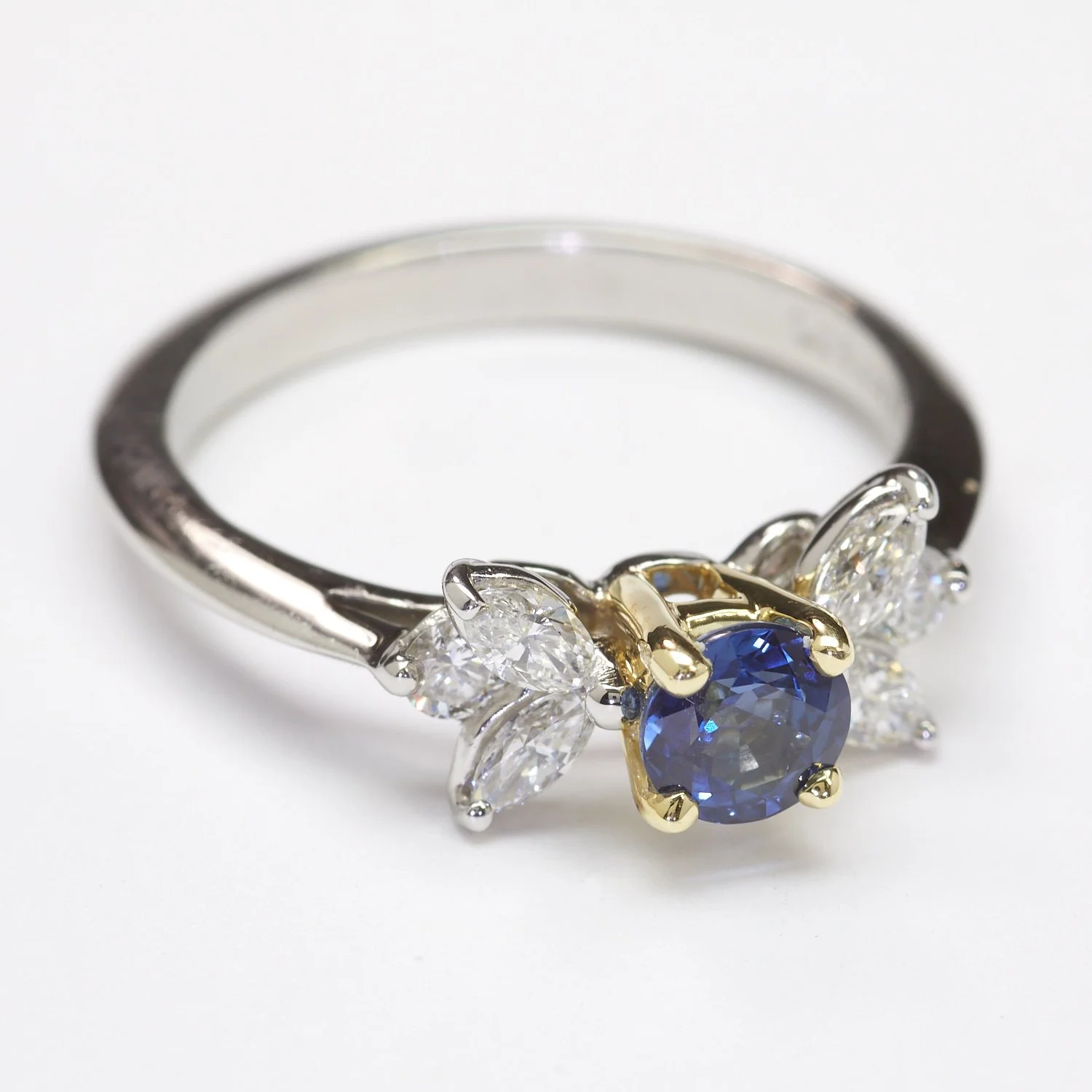
Platinum/18-karat gold estate ring with sapphire and diamonds. Signed Tiffany & Co.
In the deepest sense, of course, the meaning of your jewelry is personal – like how the light in her eyes reflected the light through the window on the morning you gave her the ring she’s worn every day since then.
But for thousands of years longer than it has been a symbol of romantic love, jewelry has constituted real wealth with basic, cashable value. Gold and silver coins were the first form of abstract, rationalized money. Diamonds, pearls, and other gemstones are neutron stars of portable wealth – unsurpassed at giving refugees new lives in new lands.
For consumers, the economic equation is Value = Quality/Price. Quality may be ranked by beauty, rarity, craftsmanship, style, nostalgia/tradition, brand popularity/prestige, or some combination of these. When we get back more than we pay, we perceive value, and we hope it will grow over time.
However, jewelry is not an investment in the financial sense. It produces no dividends, rental income, or other regular revenue stream. What it does is to behave as an asset; the payoff comes when it is sold. If it sells for more than was paid (inflation considered), it has appreciated – the opposite of depreciation.
Most of the jewelry sold in the world is not rare or fine, but instead of middle-market to lower commercial quality. This reality is inevitable in modern mass markets. Therefore, most estate jewelry, which is any jewelry held by ultimate consumers, falls somewhere along the scale of mediocre to poor quality.
What has the incredible increase in gold prices done to the estate jewelry market? In 2025’s holiday season, the price of gold leaped 50%, from about $2,600 per fine ounce a year earlier to $4,000. This means that much estate jewelry can be scrapped for more than was paid, due not to appreciation but to geopolitics and the world economy.
Gold’s dramatic price increase continues its rising trend of the past ten years. It coincides with what has been called The Great Wealth Transfer from baby-boomers to Millennials and subsequent generations. These developments have released a torrent of jewelry onto the scrap precious metals market, while some of it finds its way at higher prices to the broad, ordinary estate jewelry market in venues like eBay and Facebook Marketplace.
The point is that the pieces of better quality constitute less and less of the overall estate jewelry market. Pieces that were made one hundred years ago, around the beginning of the Art Deco period, are considered antique by Federal Trade Commission standards. No more of them can be manufactured, of course (or they would be new, not old), so over the decades, the supply has dwindled, due to sale, inheritance, loss, or damage. Meanwhile, the demand has grown.
Nowhere has the thirst for “the good stuff” been more evident than in the growth of the luxury resale market, jewelry in particular. According to the Bain-Altagamma Luxury Goods Worldwide Market Study, the global secondhand luxury market reached $55 billion in 2025. The report stated that watches and fine jewelry accounted for approximately 83% of that total.
The total global secondhand fashion and luxury market is growing by 10% annually, which is three times faster than the primary market, according to another study last year from the Boston Consulting Group (BCG) and Vestiaire Collective.
All of this points to the old adage that “the rich get rich and the poor get poorer,” or, in economic terms, the K-shaped economy. In this bifurcated world, those holding stocks, high-end homes, and high tech/AI investments are prospering; participants in older segments of the economy – wage earners – are suffering.
This translates directly to jewelry. While resale prices at the low end of the market decline to the baseline of intrinsic precious metal value, those for “the good stuff” rise higher, as it becomes rarer all the time.
Another example of this K-shaped bifurcation is the rise of lab grown diamonds, which is the biggest event in the diamond business since the discovery of the mines in 1866 in South Africa. Those first mines democratized the diamond market. Eventually, the new supply enabled almost everyone in the world to own a diamond.
When colorless lab grown diamonds were released into the diamond market in 2015, it was like finding an above-ground mine of limitless supply. As technology has improved, their prices have declined by more than 90% in the last five years. The competition has killed wholesale and resale prices of natural diamonds, especially those of smaller size and poorer quality.
Finer natural diamonds of about two carats or more have begun to recover. We appear to be entering a period of higher prices for finer natural stones. As one industry authority puts it, selling fewer diamonds to fewer people with the money to afford the real thing.
The larger story is not simply the growth of resale. It is the growing appreciation for objects of individuality, history, and quality – the things that create lasting value. For thirty five years, I have specialized in estate jewelry.
It is not necessary to spend thousands of dollars to own jewelry that is faithful to a vision – of the time it was created or the inspiration of its creator – and created with an artisan’s care for workmanship. This moves an object beyond the mass market.
Estate jewelry rewards knowledge of the elements of quality. Age alone does not make a piece desirable, nor does a famous name guarantee good character. Evaluating an item’s quality, style, condition, and price are all essential to providing value.
That is where my fifty years of total experience in the jewelry business is important to you. As I assemble this season’s estate jewelry collection, I look for pieces that are distinctive and wearable, at prices which I know provide good value to the buyer.
If you are buying or selling estate jewelry, I want to start a conversation with you.